
Airing down is one of the easiest ways to improve traction and ride quality off-road. But eventually, the trail ends—and those tires have to come back up to street pressure.
That's where choosing the right air compressor matters.
A compact inflator might be perfect for a UTV or emergency kit, while someone regularly airing four 35- or 37-inch tires from trail pressure may quickly become frustrated waiting on a small compressor.
So how much compressor do you actually need?
The answer depends primarily on your tire size, how far you air down, and how often you use it.
First: What Does CFM Mean?
When comparing air compressors, you'll commonly see a specification called CFM, or cubic feet per minute.
In simple terms, CFM tells you how much air a compressor can move.
More CFM generally means a compressor can fill a tire faster.
That's particularly important with off-road tires because increasing tire size dramatically increases the volume of air that needs to be replaced after airing down.
A compressor that feels perfectly adequate on a small ATV tire may take considerably longer when asked to inflate a 35-inch truck tire.
Tire Size Changes Everything
Consider two vehicles returning from the same trail.
One is a UTV running relatively small tires.
The other is a loaded overland truck running 35s that were aired down to 15 PSI.
Both vehicles need compressed air, but they're asking the compressor to perform very different jobs.
That's why we generally look at compressors in three categories.
Compact Compressors: Best for UTVs, Motorcycles and Emergency Use
A small compressor makes a lot of sense when portability matters more than maximum inflation speed.
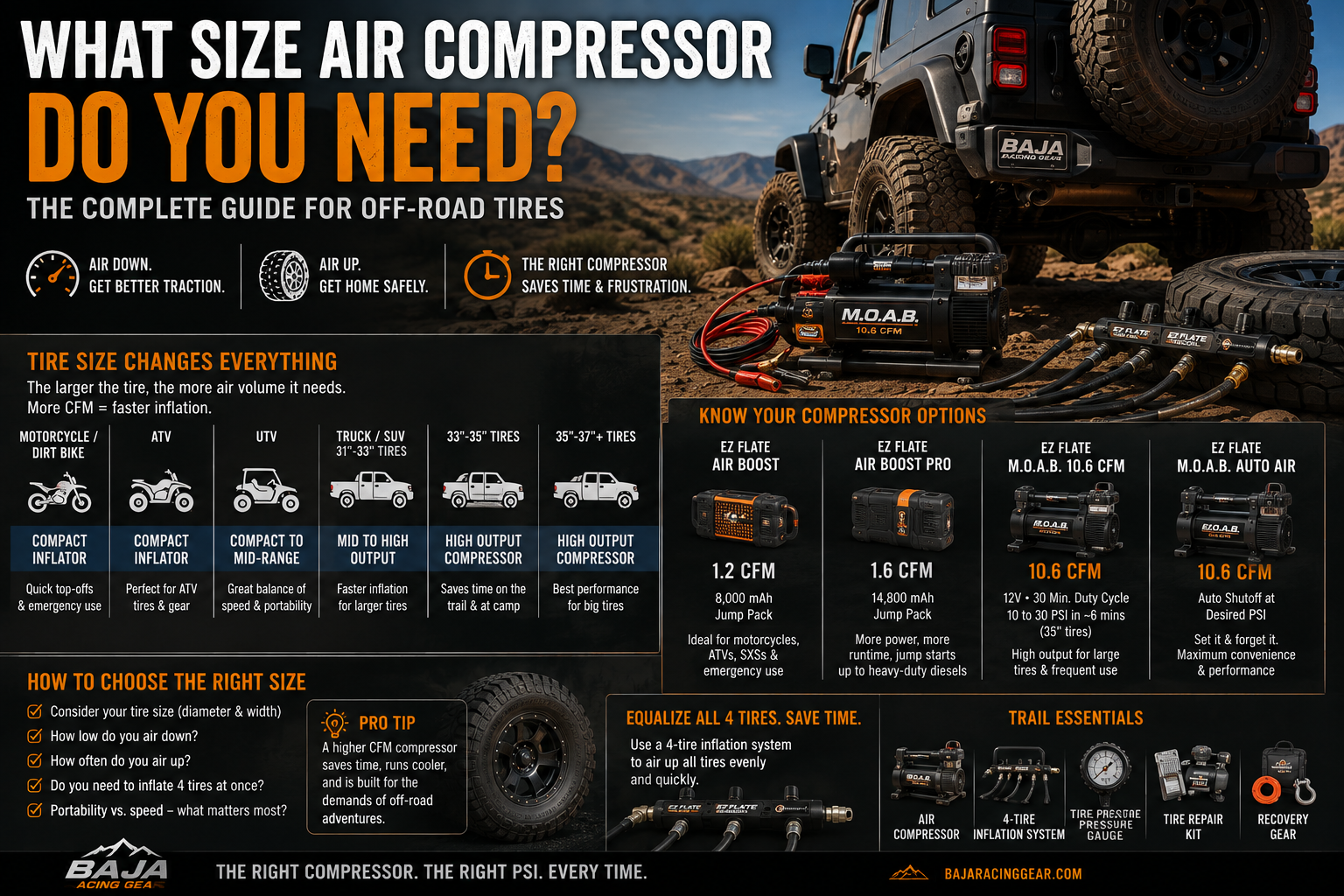
Baja Racing Gear's EZ FLATE Air Boost, for example, produces 1.2 CFM and combines the compressor with an 8,000 mAh jump pack. EZ FLATE positions it for bikes, motorcycles, ATVs, SXSs and emergency inflation of automotive tires.
That's an important distinction.
There's a difference between a compressor being capable of inflating a large tire and being the compressor you'd want to use every weekend to air up four large tires.
For a UTV, motorcycle, ATV or vehicle emergency kit, a compact compressor can be an excellent choice.
For four 35-inch tires every Saturday? We'd want more airflow.
Stepping Up: Air Boost Pro
The EZ FLATE Air Boost Pro increases output to 1.6 CFM while retaining the portable compressor/jump-pack format.
It also uses a larger 14,800 mAh battery and can serve as a jump starter for vehicles up to heavy-duty diesels.
This makes it an attractive all-around emergency tool for someone who wants one compact device capable of handling several jobs.
But once you're regularly airing down large truck tires, there's another category worth considering.
Large Off-Road Tires Need Airflow
If you regularly run 33-, 35-, 37- or 40-inch tires, inflation speed becomes much more important.
This is where a high-output dual-cylinder compressor starts making sense.
The EZ FLATE M.O.A.B. 10.6 CFM Dual Air Compressor produces 10.6 CFM / 300 LPM, operates from a 12V vehicle battery and has a 30-minute runtime at a 50% duty cycle.
That's a massive jump from a compact inflator.
According to EZ FLATE's testing cited on Baja Racing Gear, the M.O.A.B. can bring a set of 35-inch tires from 10 PSI to 30 PSI in approximately six minutes when used in the described setup.
For someone who airs down almost every trip, those saved minutes add up quickly.
What About 33s, 35s and 37s?
There's no universal CFM requirement for a particular tire diameter because tire width, wheel diameter, starting pressure and target pressure all affect inflation time.
But here's a practical way to think about it:
| Setup | Compressor Type to Consider |
|---|---|
| Motorcycle / dirt bike | Compact inflator |
| ATV | Compact inflator |
| UTV | Compact to high-output compressor |
| Occasional automotive emergency use | Compact inflator / jump-pack combo |
| 31–33" tires, occasional airing down | Mid/high-output compressor |
| 33–35" tires, frequent trail use | High-output compressor |
| 35–37"+ tires, frequent airing down | High-output dual-cylinder compressor |
| Four large tires simultaneously | High-output compressor + multi-tire system |
The important distinction is frequency.
If you only need air after repairing a flat, waiting several minutes isn't a big deal.
If you're airing down at the beginning of every trail and airing up four tires before driving home, compressor speed becomes a quality-of-life upgrade very quickly.
Don't Ignore Duty Cycle
CFM isn't the only number that matters.
You also need to consider duty cycle.
Compressing air generates heat. A compressor's duty cycle tells you how long it can operate within a specified period before it needs time to cool.
This becomes increasingly important as tire size increases because larger tires require longer compressor runtimes.
A small compressor might have enough pressure capability to inflate a large tire, but that doesn't necessarily mean it was designed to inflate four of them consecutively from low trail pressures.
That's another reason purpose-built off-road compressors make sense for larger vehicles.
Automatic Shutoff Makes Airing Up Easier
There's also a difference between power and convenience.
The EZ FLATE M.O.A.B. Auto Air 10.6 CFM Compressor adds a digital pressure-selection system.
Set your desired PSI and the system automatically checks pressure and stops when that target is reached. It retains the M.O.A.B.'s 10.6 CFM output.
That's particularly useful if airing tires is something you do regularly.
Instead of constantly checking a gauge:
Set the pressure. Let the compressor work. Get back on the road.
One Tire at a Time vs. Four Tires at Once
There's another way to make airing up easier that has nothing to do with buying a larger compressor.
Connect all four tires together.
Baja Racing Gear carries EZ FLATE Recoil and Hyperflex four-way hose systems that allow multiple tires to be connected through a manifold.
This has two major benefits.
First, all four tires can equalize to the same pressure.
Second, a high-output compressor can distribute its airflow across all four tires rather than requiring you to move from wheel to wheel.
EZ FLATE actually recommends pairing the 10.6 CFM M.O.A.B. with one of its multi-tire hose systems because of the compressor's high airflow.
For frequent off-roaders, this can turn airing up from a chore into something you largely set up and let run.
What Size Compressor Should You Buy?
Think about your actual use rather than buying based solely on specifications.
For motorcycles, ATVs and many UTV users:
A compact inflator provides portability without taking up much storage space.
For an emergency kit:
A compressor/jump-pack combination such as the Air Boost or Air Boost Pro gives you several emergency functions in one device.
For trucks and SUVs that occasionally air down:
Look for enough airflow that you're comfortable with the amount of time you'll spend airing four tires back up.
For 35s, 37s and larger tires that get aired down regularly:
A high-output dual-cylinder compressor such as the M.O.A.B. becomes much easier to justify.
For frequent off-roaders who want the easiest setup:
Combine a high-output compressor with a four-tire inflation system and automatic pressure control.
Bigger Isn't Always Better
It's easy to look at 1.2 CFM versus 10.6 CFM and assume everyone should buy the larger compressor.
That's not necessarily true.
A 25-pound high-output compressor would be unnecessary for someone primarily riding a motorcycle who wants an emergency inflator tucked into their gear.
Likewise, a tiny battery-powered compressor probably isn't the ideal tool for someone airing four 37-inch tires from trail pressure every weekend.
The best compressor is the one sized appropriately for your tires and how you actually use your vehicle.
Baja Academy Bottom Line
If you remember only one thing from this guide, remember this:
The larger your tires and the more frequently you air down, the more valuable high CFM becomes.
Occasional emergency inflation favors compactness and versatility.
Frequent off-road inflation favors airflow, duty cycle and speed.
And once you're regularly airing four large tires, a high-output compressor paired with a multi-tire inflation system can dramatically reduce the amount of time you spend sitting at the trailhead waiting to get back to road pressure.

