
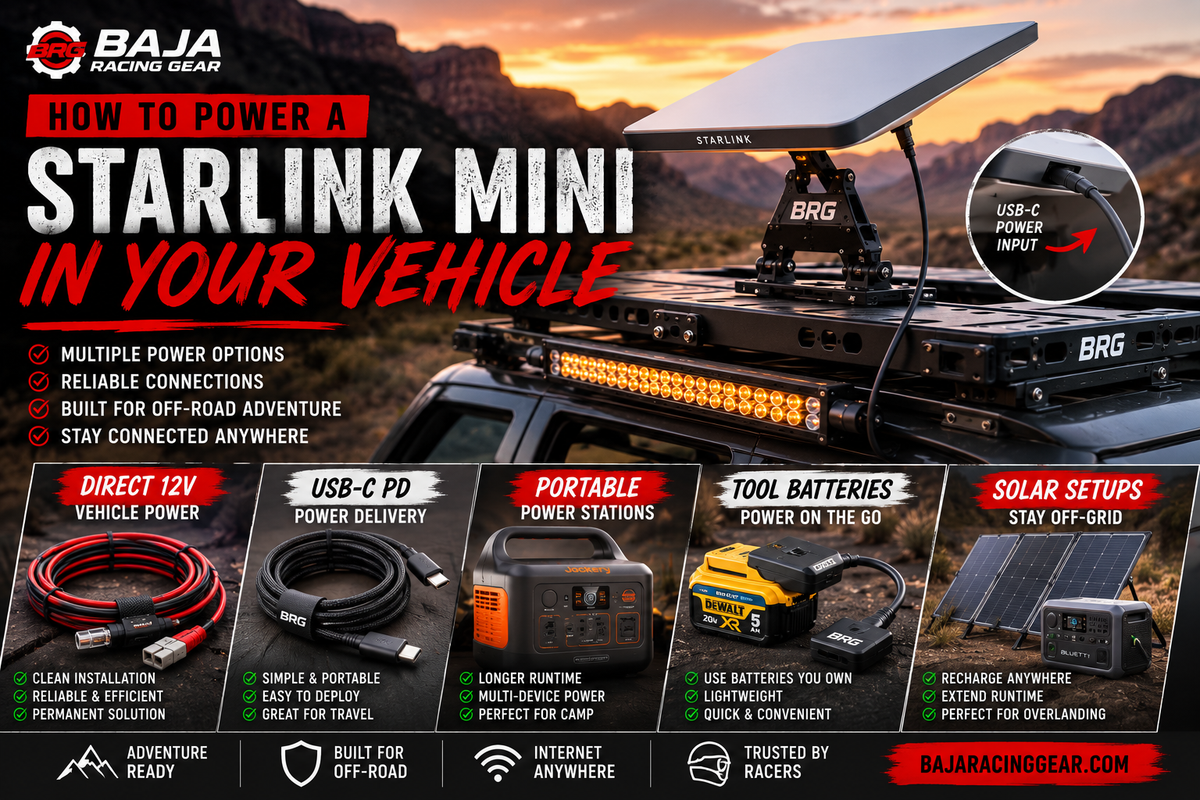
How to Power a Starlink Mini in Your Vehicle
One of the first questions people ask after buying a Starlink Mini is, "How do I power it in my vehicle?"
The good news is that there are several reliable ways to keep your Starlink Mini running, whether you're camping for the weekend, overlanding across the country, chasing race vehicles through the desert, or working remotely from the trail.
The best solution depends on how you use your vehicle. In this guide, we'll explain the most common power options, their advantages, and which setup is right for your adventure.
Understanding Starlink Mini Power Requirements
Before choosing cables or adapters, it's important to understand what the Starlink Mini needs.
Unlike many electronics that simply plug into a standard USB charger, the Starlink Mini requires a USB-C Power Delivery (PD) power source capable of supplying enough wattage to operate consistently. Using an undersized charger or poor-quality cable can cause connection issues, unexpected shutdowns, or prevent the dish from powering on altogether.
Always use quality power accessories designed to meet the Starlink Mini's requirements.
Option 1: USB-C Power Delivery
For many users, USB-C PD is the easiest solution.
This setup works well when:
- Traveling occasionally
- Camping on weekends
- Using portable battery packs
- Moving the Starlink Mini between vehicles
Advantages
- Quick and easy setup
- No permanent vehicle modifications
- Lightweight
- Portable
- Ideal for temporary installations
Considerations
Choose a high-quality USB-C PD power source. Not all USB-C chargers deliver the same amount of power, even if they use the same connector. Our Starlink Mini Battery Pack is purpose-built to deliver the right output — no guessing required. For extended adventures, the Peakdo LinkPower2 27500 mAh Battery Pack offers serious capacity to keep you connected all day.
Option 2: Direct 12-Volt Vehicle Power
For overlanders and frequent travelers, direct vehicle power is often the preferred solution.
Instead of relying on inverters or portable batteries, dedicated vehicle power cables allow the Starlink Mini to draw power directly from your electrical system.
Advantages
- Clean installation
- Reduced energy loss
- Always available
- Excellent for permanent installations
- Great for chase trucks and expedition vehicles
Best For
- Overlanding
- Race support vehicles
- Daily use
- Fleet vehicles
- Remote work setups
We carry several purpose-built cables for this type of installation:
- Starlink Mini DC Power Cable – Direct to Battery — the cleanest permanent install, wired straight to your vehicle's battery terminals with proper fusing.
- Starlink Mini DC Power Cable – Cigarette Lighter Port — a plug-and-play option for quick, no-drill setups.
- Short Starlink Mini DC Cable (16.4 ft Replacement) — ideal when routing cable through tight spaces or replacing a worn cable.
- DC Power Cable – Direct to USB-C — for dish-only setups requiring a clean USB-C feed from your 12V system.
When installing any electrical accessory, always follow proper wiring practices and protect the circuit with the appropriate fuse.
Option 3: Portable Power Stations
Portable power stations have become incredibly popular for camping and remote work.
Brands like Jackery, EcoFlow, Bluetti, DJI, and Anker make it easy to run a Starlink Mini for extended periods without touching your vehicle's battery.
Advantages
- Portable
- Rechargeable
- Can power multiple devices
- Excellent around camp
Best For
- Base camps
- RVs
- Weekend camping
- Emergency backup power
Option 4: Tool Battery Adapters
One of the newest trends is powering Starlink Mini from cordless tool batteries.
If you already own batteries from brands like Milwaukee, DeWalt, Makita, or Ryobi, battery adapters can provide a compact, portable power source.
Advantages
- Lightweight
- Easy to swap batteries
- Great emergency backup
- Uses batteries you may already own
Best For
- Day trips
- Hunting
- Trail rides
- Temporary deployments
We carry adapters for the most popular tool battery platforms:
- Makita 18V Battery Adapter Cable — pairs with any Makita 18V Li-Ion battery for a compact, swappable power source.
- DeWalt Battery Adapter Cable — if your toolbox runs DeWalt, this turns your existing batteries into Starlink power.
- Ryobi 18V ONE+ Battery Adapter Cable — 1-meter cable compatible with the entire Ryobi ONE+ battery lineup.
Option 5: Solar-Powered Camps
Many overlanders combine solar panels with auxiliary batteries or portable power stations.
Solar isn't usually connected directly to the Starlink Mini. Instead, it replenishes your battery system throughout the day, allowing you to operate Starlink for longer periods while staying off-grid.
Ideal for:
- Long camping trips
- Remote work
- Extended overland travel
Common Mistakes to Avoid
We've seen a few common issues that can prevent a reliable Starlink setup.
Using Cheap USB-C Chargers
Not every USB-C charger provides enough power for a Starlink Mini.
Buying Low-Quality Cables
Poorly made cables can create voltage drop or intermittent power problems.
Ignoring Cable Management
Loose cables can become damaged from vibration, sharp edges, or repeated opening and closing of doors and hatches.
Running Without Circuit Protection
Any permanent 12V installation should be properly fused to protect both your equipment and your vehicle.
Which Power Option Is Best?
There isn't one universal answer.
For occasional users, a quality USB-C PD setup with one of our Starlink Mini Battery Packs is often the easiest solution.
For serious overlanders or race teams, a dedicated direct-to-battery 12V cable offers the cleanest and most reliable long-term setup.
Portable power stations remain an excellent choice for people who want flexibility, while tool battery adapters provide a convenient backup option for shorter adventures.
The right solution depends on how you travel and how often you use your Starlink Mini.
Frequently Asked Questions
Can I run a Starlink Mini directly from my vehicle?
Yes, with the proper power cable and wiring. Our Starlink Mini DC Power Cable – Direct to Battery is designed exactly for this use case.
Will a Starlink Mini drain my battery?
Like any electrical accessory, it draws power while operating. If you're using it with the engine off, monitor your battery or use an auxiliary battery or portable power station.
Can I power it from a USB-C battery bank?
Yes, provided the battery bank supports the required USB-C Power Delivery output. Our Starlink Mini Battery Pack is pre-configured to deliver the right specs.
Do I need an inverter?
In many cases, no. Direct 12V or USB-C PD solutions are typically more efficient than converting DC to AC and back again.
Shop Starlink Power Accessories
At Baja Racing Gear, we carry Starlink Mini power solutions designed for off-road travel, overlanding, race support, and remote adventures. Whether you're looking for a permanent vehicle installation or a portable camp setup, we're here to help you build a reliable system that fits the way you travel.
Shop our most popular power accessories:
- Starlink Mini DC Power Cable – Direct to Battery
- Starlink Mini DC Power Cable – Cigarette Lighter Port
- Starlink Mini Battery Pack
- Peakdo LinkPower2 27500 mAh Battery Pack
- Makita 18V Battery Adapter Cable
- DeWalt Battery Adapter Cable
- Ryobi 18V ONE+ Battery Adapter Cable
Or browse the full Starlink collection to find compatible cables, adapters, and mounting solutions for your next adventure.

