
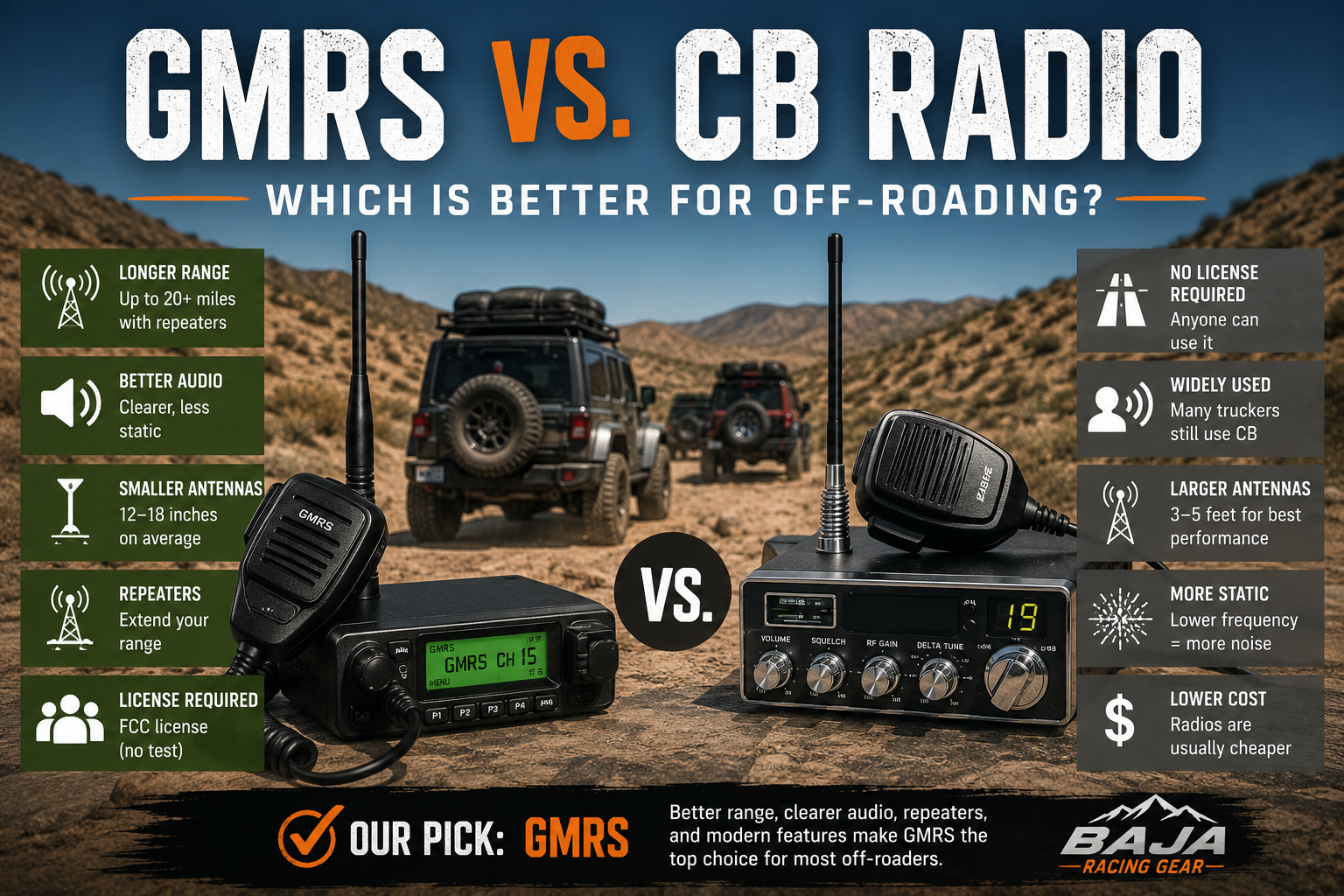
Whether you're heading into the Arizona backcountry, exploring forest roads in Colorado, or leading a weekend trail ride, reliable communication is one of the most important pieces of gear you can bring.
For decades, CB radios were the standard for off-road communication. Today, however, many overlanders, Jeep clubs, UTV groups, and off-road organizations have made the switch to GMRS. Does that mean CB is obsolete? Not necessarily—but for most people, GMRS is the better choice.
In this guide, we'll compare both systems, explain their strengths and weaknesses, and help you decide which one belongs in your vehicle.
Quick Comparison
| Feature | GMRS | CB Radio |
|---|---|---|
| Typical Range | 2–20+ miles | 1–5 miles |
| Audio Quality | Excellent | Fair |
| License Required | Yes (FCC license, no test in the U.S.) | No |
| Repeaters Available | Yes | No |
| Antenna Size | Small | Large |
| Installation | Easy | Moderate |
| Popular with Modern Off-Road Groups | Very High | Declining |
Winner for most off-roaders: GMRS
What Is GMRS?
GMRS (General Mobile Radio Service) is a two-way radio service designed for short- to medium-range communication. Unlike inexpensive FRS walkie-talkies, GMRS radios operate at higher power levels and can use external antennas, mobile radios, and repeaters to dramatically extend range.
Modern GMRS radios provide:
-
Clear audio
-
Long communication distances
-
Small antennas
-
Mobile vehicle installations
-
Handheld compatibility
-
Repeater access for extended coverage
Because of these advantages, GMRS has become the communication system of choice for many off-road clubs and overland communities.
What Is CB Radio?
CB (Citizens Band) radio has been around since the 1970s and became famous during the trucking boom.
It still has advantages:
-
No FCC license required
-
Huge installed user base
-
Inexpensive equipment
-
Works without cellular service
Many truck drivers continue to monitor CB Channel 19, making it useful for highway travel and traffic information.
However, CB technology hasn't changed much over the years, and it comes with several limitations that have pushed many off-road enthusiasts toward GMRS.
Audio Quality
GMRS
GMRS uses UHF frequencies that generally produce much cleaner audio.
You'll hear:
-
Less static
-
Better voice clarity
-
Easier conversations
-
Less background noise
Even at longer distances, conversations often remain understandable.
CB Radio
CB uses lower frequencies that are more susceptible to:
-
Electrical interference
-
Static
-
Engine noise
-
Atmospheric conditions
If you've ever heard the classic "crackly" CB sound, you've experienced one of its biggest drawbacks.
Winner: GMRS
Communication Range
One of the biggest misconceptions is that radio advertisements always represent real-world performance.
Actual range depends on:
-
Terrain
-
Trees
-
Mountains
-
Antenna quality
-
Vehicle placement
-
Weather
Typical Off-Road Range
-
1–5 miles
-
5–20+ miles
GMRS Using Repeaters
-
30–50+ miles is possible in favorable conditions.
Typical CB Range
-
1–5 miles
-
Occasionally farther under ideal conditions
-
Significantly reduced in mountainous terrain
Because most off-road trips involve hills, canyons, and forests, GMRS generally provides much more reliable communication.
Winner: GMRS
Antenna Size
This is a major reason many people switch.
CB Antennas
For best performance, CB typically requires a much longer antenna.
Common sizes include:
-
3 feet
-
4 feet
-
5 feet
-
102-inch whip antennas
Large antennas can:
-
Catch tree branches
-
Hit garage doors
-
Create wind noise
-
Flex excessively on rough trails
GMRS Antennas
GMRS antennas are much smaller while still providing excellent performance.
Many quality mobile antennas are only 12–18 inches tall, making them easier to live with on a daily-driven vehicle.
Winner: GMRS
Installation
Installing a CB
A proper CB installation often requires:
-
Large antenna mount
-
Quality coax cable
-
SWR tuning
-
Radio mounting
-
Power wiring
Many first-time users struggle with antenna tuning.
Installing GMRS
Most GMRS mobile radios are straightforward:
-
Mount the radio.
-
Install the antenna.
-
Connect power.
-
Select a channel.
No SWR tuning is required with most GMRS setups, making installation much simpler for beginners.
Winner: GMRS
Licensing
One area where CB still has an advantage is simplicity.
CB Radio
No license required.
Anyone can purchase one and begin using it immediately.
GMRS
GMRS requires an FCC license in the United States.
The good news is:
-
No exam
-
Simple online application
-
Covers your immediate family
-
Valid for multiple years
For many people, obtaining a license is a one-time task that's well worth the improved performance.
Repeaters
This is one of GMRS's biggest advantages.
Repeaters are stations installed on elevated locations that receive your transmission and retransmit it over a much larger area.
Benefits include:
-
Extended communication range
-
Better emergency communication
-
Wider trail coverage
-
Improved reliability in mountainous terrain
CB radios do not support repeaters.
Winner: GMRS
Which One Do Most Off-Road Clubs Use?
The trend over the last several years has been clear.
Many Jeep clubs, Toyota groups, overlanding communities, and organized trail rides now recommend or require GMRS because it offers:
-
Better clarity
-
Longer range
-
Smaller antennas
-
Easier installations
-
More reliable communication
Some long-established groups still use CB, but GMRS adoption continues to grow rapidly.
When Does CB Still Make Sense?
CB is still a solid choice if:
-
You primarily travel highways.
-
You want truck-driver traffic updates.
-
Your trail group already uses CB.
-
You don't want to obtain a GMRS license.
If your entire group communicates on CB, using CB is still the practical choice.
When Should You Choose GMRS?
GMRS is likely the better option if you:
-
Go overlanding regularly.
-
Join organized trail rides.
-
Want clearer communication.
-
Need greater range.
-
Prefer a compact antenna.
-
Plan to expand your communication setup in the future.
For most modern off-road enthusiasts, GMRS checks every box.
Frequently Asked Questions
Can GMRS talk to CB radios?
No.
They operate on completely different frequencies and cannot communicate directly.
Can handheld GMRS radios talk to vehicle-mounted GMRS radios?
Yes.
As long as they're programmed to the same channel and privacy code settings (if used), handheld and mobile GMRS radios work together seamlessly.
Is GMRS worth the license?
For most off-road enthusiasts, yes.
The improved range, audio quality, and repeater access make the small amount of paperwork worthwhile.
Which radio is best for overlanding?
For most overland travel, GMRS offers the best combination of clarity, range, ease of installation, and future expandability.
Final Verdict
CB radio helped define off-road communication for decades, and it still has its place. But technology has moved forward.
For today's trail riders, campers, overlanders, and weekend explorers, GMRS provides clearer audio, longer range, easier installation, and a more modern communication experience.
If you're building an off-road vehicle from the ground up, GMRS is the system we'd recommend starting with.
Reliable communication can make every trip safer, more enjoyable, and better coordinated—whether you're spotting a technical obstacle, calling out wildlife, or simply letting the group know you're ready to roll.
Looking for a GMRS Radio?
Baja Racing Gear offers GMRS radios and communication accessories designed for off-road adventures. Whether you're outfitting a daily-driven overland rig or a dedicated trail vehicle, choosing the right communication system is one of the best upgrades you can make before your next adventure.

