
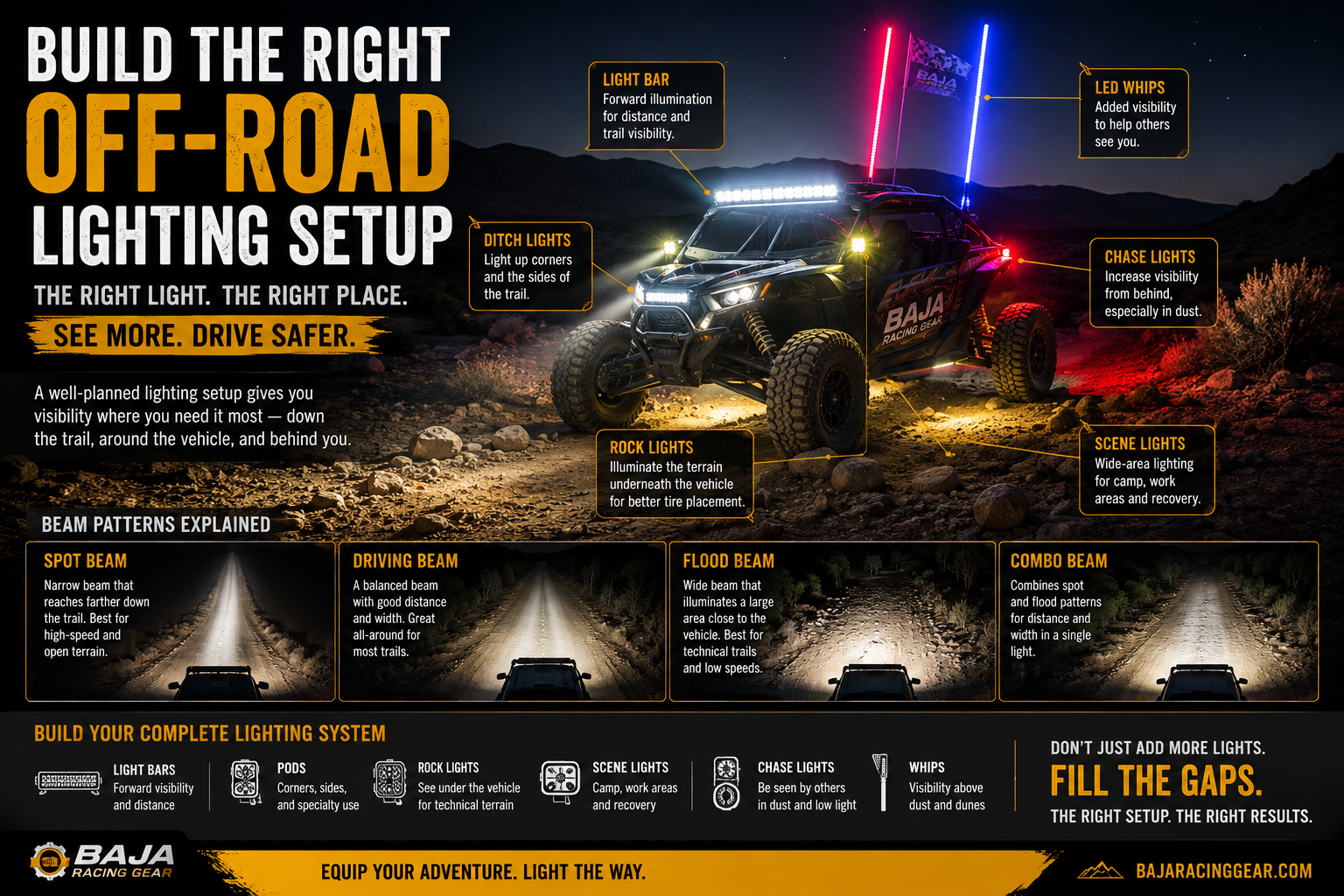
Adding lights is one of the most popular upgrades for trucks, Jeeps, UTVs, and other off-road vehicles.
But a good off-road lighting setup isn't simply about putting the biggest light bar you can fit on the roof.
Different lights solve different problems.
A light bar may help you see farther down a fast desert trail. Scene lights can illuminate the sides of your vehicle. Rock lights help with tire placement on technical terrain. Chase lights help other drivers see you through dust.
The goal isn't necessarily to create more light.
It's to put the right light in the right place.
This guide explains the major types of off-road lighting, what different beam patterns actually do, and how to build a lighting system around the way you use your vehicle.
Start With Beam Pattern: Spot vs. Flood vs. Combo
Before choosing the type or size of light, it's important to understand where that light is going.
Two lights can produce similar amounts of total light while performing completely differently on the trail.
Spot Beam
A spot beam concentrates light into a narrow pattern that reaches farther ahead of the vehicle.
Spot lighting works particularly well for:
- High-speed desert driving
- Racing
- Open terrain
- Long straight trails
- Seeing obstacles earlier at speed
The tradeoff is width.
A powerful spot beam may let you see far down the trail while leaving the edges and corners relatively dark.
Flood Beam
Flood lights spread their output across a much wider area closer to the vehicle.
They're useful for:
- Slow technical trails
- Rock crawling
- Campsites
- Work areas
- Tight trails
- Peripheral visibility
Flood lighting sacrifices some long-distance visibility in exchange for a much wider field of view.
Combo Beam
Combo lights attempt to provide both.
Depending on the design, portions of the light may concentrate illumination downrange while other optics spread light outward.
That makes combo patterns extremely useful for recreational off-road vehicles that encounter a variety of terrain.
Driving Beam
Driving patterns generally fall somewhere between a dedicated spot and a wide flood.
You get useful distance without concentrating all of the available light into one narrow area.
For general trail driving, that's often exactly what you want.
Light Bars: Your Primary Forward Lighting
LED light bars are probably the first thing most people picture when they think about off-road lighting.
And for good reason.
A properly selected light bar can provide a huge improvement in forward visibility.
Baja Racing Gear carries several styles from All Terrain Concepts, including Super Slim, Dual Slim, EE Series, Mini Race Series, and Race Series lighting.
But bigger isn't automatically better.
A large roof-mounted bar might provide tremendous output, while a smaller bumper-mounted light with the right optics could provide more useful illumination for your particular style of driving.
Light bars work especially well for:
Bumper mounting: Primary forward illumination without placing the light directly above the windshield.
Grille mounting: Clean installation with good forward projection.
Roof mounting: Maximum potential coverage and distance, particularly useful for high-speed desert applications.
There's one thing to consider with roof lighting, though:
hood glare.
A powerful roof-mounted light can illuminate your hood and create reflected light directly in the driver's field of view. Dust, fog, and other airborne particles can also become more noticeable when illuminated from high on the vehicle.
Placement matters.
LED Pods: Small Lights With a Lot of Possibilities
Pods are arguably one of the most versatile forms of off-road lighting.
Because they're small, they can be mounted almost anywhere.
Depending on the optics, pods can serve as:
- Driving lights
- Spot lights
- Ditch lights
- Scene lights
- Reverse lights
- Work lights
- Cornering lights
Baja Racing Gear carries options such as All Terrain Concepts Mini Scene and Side Shooter lights along with high-output pod options from Marshin Whips.
The trick is choosing an optic and mounting location that solves a specific visibility problem.
Ditch and A-Pillar Lights
One of the most popular places to install pods is near the base of the windshield.
These are commonly called ditch lights.
Rather than pointing them straight ahead, they're usually aimed slightly outward.
This fills the dark areas beside your headlights and primary driving lights.
Ditch lights can make it easier to see:
- Trail intersections
- Animals
- Rocks
- Drop-offs
- Tight corners
- Trees and brush
- Obstacles entering the trail
A wide or side-shooting optic makes a lot of sense in this position.
If your bumper lights already illuminate straight ahead, there's little reason for your ditch lights to do exactly the same job.
Scene Lights: Illuminate the Area, Not Just the Trail
Sometimes you don't need to see half a mile away.
You need to see what's ten feet beside you.
That's the purpose of scene lighting.
Scene lights produce broad illumination around the vehicle and are useful for:
- Setting up camp
- Working on a vehicle
- Changing a tire
- Recoveries
- Loading trailers
- Pit areas
- Nighttime repairs
They can be mounted on the sides or rear of a vehicle to create a usable work area.
For an overland or camping build, scene lighting can be every bit as useful as forward-facing trail lights.
Rock Lights: See What's Under the Vehicle
Rock lights aren't just cosmetic.
For technical off-roading, they can be extremely useful.
Rock lights are mounted underneath the vehicle and illuminate the terrain immediately surrounding the tires and suspension.
Baja Racing Gear carries dedicated systems including Marshin Rosewell rock lights and All Terrain Concepts Bluetooth-controlled rock-light kits.
They can help illuminate:
- Tire placement
- Rocks
- Drop-offs
- Suspension obstacles
- Terrain underneath the vehicle
This is especially useful when crawling at night.
Instead of relying entirely on a spotter with a flashlight, properly positioned rock lights can give both the driver and spotter a much clearer view of what's happening underneath the vehicle.
And yes—they also look pretty good around camp.
Chase Lights: Being Seen Matters Too
Not every off-road light exists to help you see.
Some help everyone else see you.
That's especially important in desert environments.
Anyone who has followed another vehicle down a dusty trail knows how quickly visibility can disappear.
A chase light mounted toward the rear of the vehicle gives following drivers another visual reference.
Baja Racing Gear carries dedicated chase-light solutions from both All Terrain Concepts and Marshin Whips.
Chase lighting is particularly valuable for:
- UTV groups
- Desert racing
- High-speed trail riding
- Dusty conditions
- Group rides
Some systems can also incorporate additional functions such as brake, running, or signaling lights depending on their design.
For vehicles regularly traveling in groups through dusty terrain, rear visibility deserves just as much consideration as forward lighting.
LED Whips: Visibility Above the Dust
LED whips have become extremely common on UTVs and dune vehicles.
There's obviously a visual/customization aspect to them, but whips also serve a practical purpose:
They put a visible light source above the vehicle.
In dunes, washes, and other terrain where another vehicle may be partially hidden, the additional height can make the vehicle easier to spot.
Baja Racing Gear carries whip systems from brands including 5150 Whips and Marshin Whips.
They're particularly useful for:
- Dunes
- UTV riding
- Group rides
- Camps
- Low-visibility environments
Just remember that lighting requirements can vary depending on where you're riding, so always check the rules for the area or event you're attending.
Don't Just Add More Lights — Fill the Gaps
This is where a lot of lighting builds go wrong.
Imagine installing:
A 40-inch forward-facing light bar.
Then two forward-facing pods.
Then two more forward-facing pods.
You've certainly created a lot of light.
But you've mostly created more of the same light.
A better lighting system fills different visibility zones.
For example:
| Lighting Position | Primary Job |
|---|---|
| Front bumper | Forward trail illumination |
| Spot/long-range lights | Distance |
| A-pillar/ditch lights | Corners and peripheral visibility |
| Rock lights | Immediate terrain/tire placement |
| Side scene lights | Camp/work area |
| Rear scene lights | Reverse/work area |
| Chase lights | Rearward visibility |
| Whips | Elevated vehicle visibility |
Now every light has a purpose.
That's the difference between simply adding lights and building a lighting system.
Lumens Aren't Everything
One of the easiest mistakes to make when shopping for off-road lighting is comparing lights solely by lumen output.
Lumens measure the total quantity of visible light produced.
That's useful information—but it doesn't tell you where the light goes.
Imagine two lights producing the same total output.
One spreads that light across an enormous area immediately around the vehicle.
The other concentrates it into a narrow beam traveling far down the trail.
Same theoretical output.
Completely different performance.
That's why optics, beam pattern, and usable light matter.
A well-designed light that puts illumination exactly where the driver needs it can be more useful than a higher-output light with an inappropriate beam pattern.
What Is Lux?
You'll sometimes see another specification called lux.
While lumens describe total light output, lux measures illumination reaching a surface.
This can be particularly useful when evaluating long-distance performance.
A properly designed reflector or lens can concentrate available light and maintain useful illumination much farther down the trail.
That's one reason quality optics matter so much in off-road lighting.
You're not simply buying LEDs.
You're buying the manufacturer's ability to control where those LEDs put their light.
What Lighting Setup Is Best for Your Vehicle?
There isn't one answer because a rock crawler, overland truck, and desert UTV have completely different needs.
Rock Crawling
Prioritize:
Flood/scene lighting + rock lights
At low speeds, immediate terrain and tire placement matter more than extreme distance.
Desert Racing
Prioritize:
Long-range spot + driving/combo lighting + chase lighting
At higher speeds, the amount of terrain you travel every second increases dramatically. Seeing obstacles earlier becomes much more important.
Rearward visibility in dust also becomes critical.
UTV Trail Riding
A well-rounded setup might include:
Driving/combo lights + ditch lights + rock lights + chase lights or whips
That provides forward visibility, peripheral illumination, low-speed terrain lighting, and improved visibility to other riders.
Overlanding
Prioritize versatility.
A good setup might combine:
Driving/combo lights + scene lighting + rear work lights
You get better trail visibility while also having useful illumination once you arrive at camp.
Dunes
Consider:
Forward driving lights + chase lights + whips
Being able to see other vehicles—and allowing them to see you—becomes especially important around dunes and elevation changes.
Don't Forget About Wiring
Adding several powerful lights also means adding electrical load.
The electrical side of the installation deserves just as much attention as the lights themselves.
A proper lighting installation may require:
- Correct wire gauge
- Relays
- Fuses or circuit breakers
- Quality connectors
- Proper grounds
- Weather-resistant connections
- Switches or a digital switch panel
Every circuit should be properly protected.
And as you add accessories, a centralized switch system can make the installation considerably cleaner than adding individual rocker switches for every new accessory.
Before installing a large lighting system, make sure your vehicle's charging system and accessory wiring can safely support the additional load.
Build Your Lighting System in Stages
You don't necessarily need to install everything at once.
Start by identifying your biggest visibility problem.
Can't see far enough ahead?
Start with quality forward driving or spot lighting.
Can't see into corners?
Add properly aimed ditch or side-shooting lights.
Struggling with tire placement at night?
Add rock lights.
Need lighting around camp?
Add scene lighting.
Other drivers can't see you through dust?
Look at chase lights or whips.
This approach also prevents you from spending money on lights that don't actually improve the way you use your vehicle.
Baja Academy Bottom Line
The best off-road lighting system isn't necessarily the one with the most lights or the highest advertised lumen number.
It's the system where every light has a job.
Use long-range lighting to see farther.
Use flood and scene lighting to see wider.
Use ditch lights to illuminate corners.
Use rock lights to see underneath the vehicle.
Use chase lights and whips to help other drivers see you.
Once you start thinking about lighting in terms of distance, width, terrain, and visibility, choosing the right lights becomes much easier.
Don't just light up the desert.
Put the light where you actually need it.
Trail Essentials
Building out your lighting system? Depending on your vehicle and the terrain you drive, consider:
- LED light bars
- Driving and spot pods
- Scene lights
- Ditch/side-shooter lights
- Rock-light kits
- Chase lights
- LED whips
- Vehicle-specific mounting brackets
- Wiring harnesses
- Switch panels and accessory controllers
You can browse Baja Racing Gear's off-road lighting selection to find lighting for everything from recreational trail rigs to UTVs and desert race vehicles.

