
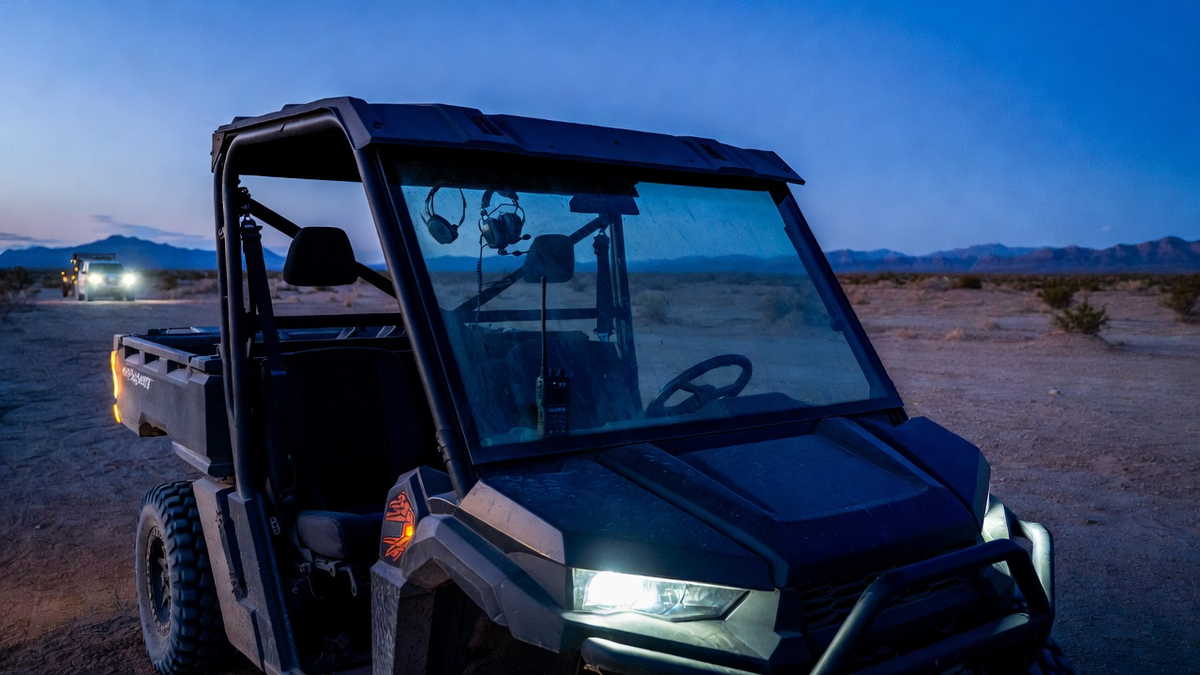
There's a special kind of desert quiet that shows up right after your phone drops from two bars to a lonely "SOS only." Your buddy's dust plume is still visible over the next ridge. Your passenger is pointing at a wash you both swear wasn't there last season. And the group chat? Might as well be smoke signals.
If you ride recreationally—weekend trails, desert exploring, friends-and-family convoys—you don't need a SCORE radio pit. You do need a two-way radio system that works when the cell tower took the day off.
Why trail crews lose the plot without radios
Recreational rides fail soft before they fail hard. The soft failures are what radios fix every single Saturday:
- Cell dead zones — washes, canyons, dune fields, and BLM expanses chew signal for breakfast. A radio doesn't care about your carrier.
- Group coordination — "Hold up," "take the left fork," "we're stopping for a pin," without everyone stacking up bumper-to-bumper.
- Hazard callouts — soft sand, oncoming traffic on a two-track, a rolled-over rock garden that looks friendly until it isn't.
- Spotting — one person out of the seat guiding another through a ledge or shelf; cabin talk plus vehicle-to-vehicle keeps that calm.
- Meetup after splits — someone takes the scenic loop, someone babysits a slow repair, someone is already at camp. Radios turn "where are you?" into a channel, not a prayer.
- "Back by dark" peace of mind — spouses, kids, and chase trucks sleep better when the pack can still key up after sunset.
None of that is race drama. It's ordinary trail competence.
Rule one before you buy: match your friends' band
Here's the expensive mistake: you research "best UTV radio," buy a solid GMRS mobile, show up Saturday… and your crew is already keyed up on business / Part 90 channels. Different services. Different radios. You can wave through the dust all day and never talk.
Ask your regular ride group what they already run—band, channel list, even the radio brand—before you spend. On a lot of Southwest trails, that answer is a PCI-style Part 90 mobile (the shared channel list PCI programs—trail talk often says Weatherman / stock). If that's your pack, buy into that ecosystem so you can hear them. If your friends are all on GMRS, then GMRS is the smart buy. Compatibility beats brochure wattage.
What actually works on trail — Part 90 first for many Southwest crews
US riders get sold a lot of range poetry. Here's the practical ladder for recreational buyers.
Business / Part 90 (PCI-style) mobiles — often the better trail fit
On many Southwest group rides, business-band Part 90 mobiles are the better vehicle-to-vehicle option: they usually outrange blister-pack FRS/handhelds for desert spacing, and—critically—a lot of trail traffic is already there. Kits like the Mobile Radio Chase Package ship as Part 90 mobiles pre-programmed for that shared-channel world (the shared list PCI programs—trail talk often says Weatherman / stock), and BRG's mobile radios collection is where those builds live. Pair the radio with a cabin intercom and you've got the recreational "system," not just a brick in a cup holder.
FCC / sharing agreement — short version (read the page before you key up)
Part 90 spectrum is license-limited; you're not free to invent frequencies. For PCI-style radios sold through PCI or authorized dealers, customers operate authorized shared channels under PCI's license (call sign WPGK938) pursuant to 47 CFR 90.179, under the terms of the PCI Race Radios FCC License Agreement. Light rules of the road from that agreement only:
- Transmit only on approved channels in the geographic areas where the frequency list allows it
- Do not transmit on channels labeled "Baja" inside the United States
- Use Part 90 radios from PCI / an authorized dealer with approved serial numbers
- Sharing membership is 12 months and renews—you're responsible for keeping it current
- PCI can revoke or change the sharing agreement; misuse can mean lost permission and FCC fines (PCI is not your lawyer or your shield)
- This is not a free pass on every pre-programmed or business frequency—follow the agreement and the frequency list
Don't treat this blog as legal advice; the agreement page is the customer-facing guideline. Read it, then transmit.
GMRS — solid alternate path (own license)
GMRS is still a legitimate recreational lane: you get your own FCC GMRS license (online ULS, no exam; typically a 10-year term and a filing fee—confirm current fee on FCC.gov), immediate family can operate under the licensee's grant (an adult 18+ holds the license), and mobiles/handhelds with detachable antennas are the usual trail kit (MXT500, MXT575 remote, GXT1000 handhelds, etc.). Choose GMRS when your crew is on GMRS—not because a search ad said "best UTV radio." If friends are on Part 90 and you buy GMRS alone, you still won't talk to them on the trail.
FRS
Licensed-by-rule bubble-pack / fixed-antenna handhelds (power capped—up to 2 W ERP on some channels, 0.5 W ERP on others). Fine for short spacing at camp. Not the ridgeline convoy solution. A lot of blister-pack "GMRS/FRS" radios still need a GMRS license if they exceed FRS limits—read the label before you key up.
UTV intercom packages
This is the piece walkie-talkies never solve: talking inside the machine at 40 mph with wind roar and belt whine. An intercom (headset or helmet wiring) lets driver and passengers converse without yelling. Pair it with whatever vehicle radio your group actually uses and you get cabin talk plus push-to-talk to other machines.
What "good enough" looks like for recreational buyers
Think in kits, not trophies—and band-match first.
- Ask the group, then pick the radio path — Part 90 / PCI-style if that's what your Southwest trail friends run; GMRS if that's the pack. Browse mobile radios (incl. the Chase Package) or GMRS once you know the answer. Mount cleanly with communication mounting solutions; antenna placement matters more than bravado claims.
- Make the cabin hearable — If you can't hear each other in the seats, vehicle-to-vehicle won't feel useful. Start with an intercom package or stereo-friendly Trax packages. The Trax Intercom Package is the "talk + music in the cabin" foundation; step up to a full Trax Communications Package or the classic mono Elite Communications Package when you want radio + intercom in one cart. Full bundles: intercom packages.
- Handheld backup for feet-on-ground — Spotting, recovery walks, kids back to camp. Match handhelds to the same service your mobiles use when you can—see hand-held radios.
- Vehicle-specific shortcuts — Can-Am X3 weekend builds: Can-Am X3 Trax Communications Package and the Can-Am X3 collection. Bluetooth/wireless add-ons: bluetooth-wireless.
Trail habits that make radios actually work
Gear without habits is just expensive silence.
- Confirm band + primary channel + backup with the whole group before you leave pavement.
- Keep transmissions short; leave air for hazard calls.
- One person shouldn't be the only radio brain—teach the passenger to key up.
- Test the install at home volume before you test it at dune volume.
- Radios coordinate your group; they're not a substitute for a real emergency plan (satellite messenger, known check-in times, recovery gear).
That's competence, not cosplay.
Bottom line
Recreational UTV riding is supposed to feel like freedom, not a scavenger hunt for who wandered off with the cooler. A two-way radio system—cabin intercom for the people next to you, and a vehicle radio on the same band your friends already use—turns dead-zone Saturdays into coordinated ones. On a lot of Southwest trails, that vehicle radio is a Part 90 / PCI-style mobile under the shared-channel agreement; GMRS is the alternate when your crew lives there. Match the group's band first, make the cabin hearable, read the FCC License Agreement if you're on the PCI path, and keep a handheld for boots-on-dirt moments. The desert will still be quiet. Your crew doesn't have to be guessing.
Shop related
- Mobile Radios — Part 90 / trail mobiles
- Mobile Radio Chase Package — Part 90 chase/trail kit
- Intercom Packages — radio + intercom bundles
- All Trax Packages — stereo Trax cabin kits
- GMRS — alternate own-license path
- Hand-Held Radios — spotting & backup
- PCI Race Radios FCC License Agreement — Part 90 sharing terms
- Communication Mounting Solutions — clean installs

