
There’s something about a campfire that’s hard to replace.
After a day on the trail, setting up camp and sitting around a fire is one of the best parts of being outdoors. But throughout much of the Southwest, traditional wood campfires come with an increasingly important consideration: wildfire risk.
Arizona, California, New Mexico and much of the western United States regularly experience periods of elevated fire danger and seasonal fire restrictions. For campers and overlanders traveling through dry country, that makes the way we cook — and the way we enjoy a fire at camp — worth thinking about.
One increasingly practical alternative is propane.
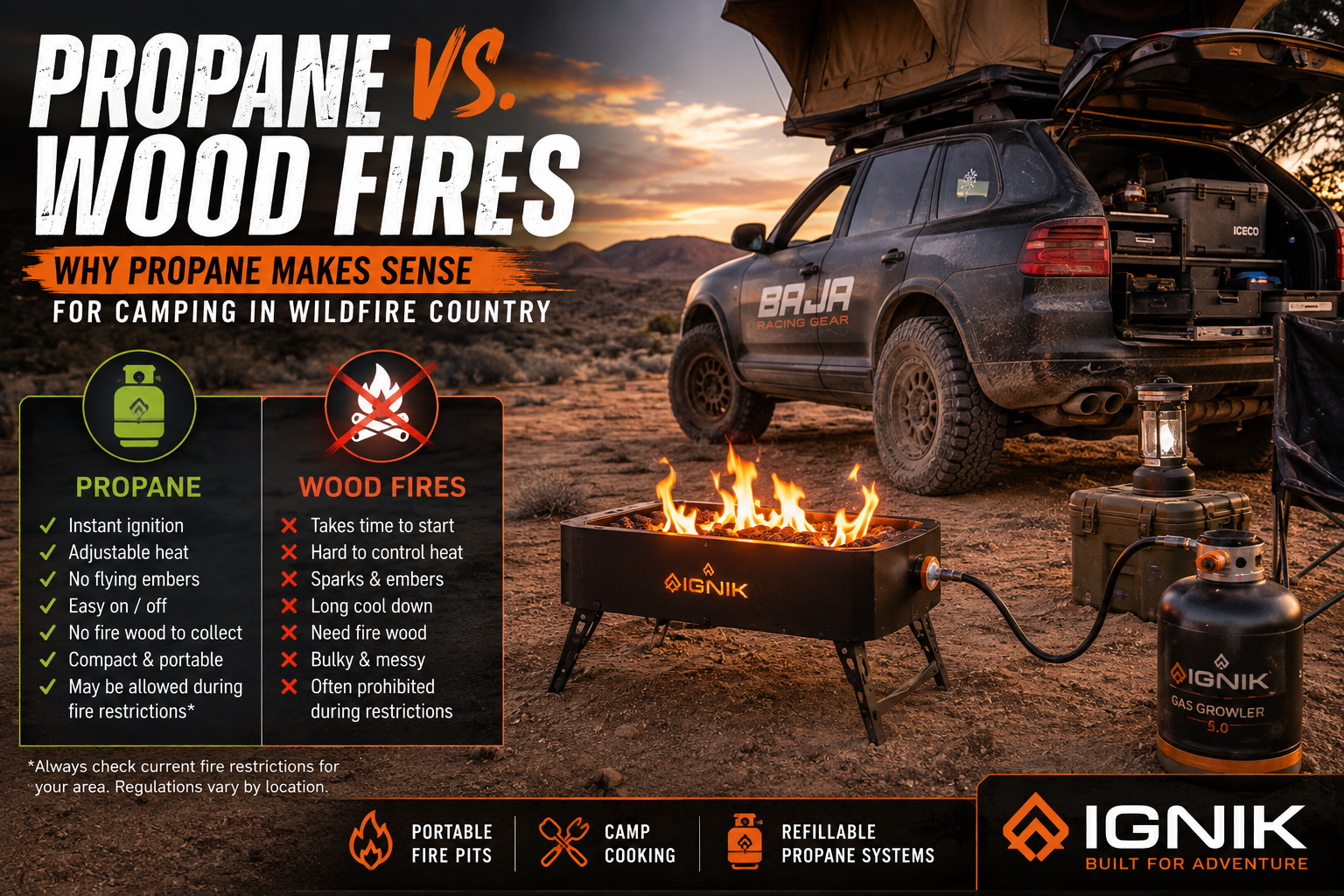
Propane won't eliminate every fire concern, and it isn't permitted under every fire restriction. But compared with a traditional wood fire, a properly used propane stove, grill or portable fire pit offers several significant advantages.
Here's what you should know before your next trip.
Why Wood Campfires Are a Problem in Dry Country
A wood fire doesn't stop being a potential ignition source just because it's inside a fire ring.
Burning wood produces sparks and embers that can be carried by wind into nearby grass, pine needles or other vegetation. Hot coals can also remain capable of starting a fire long after the visible flames disappear.
Then there's extinguishing it.
A wood campfire needs to be completely drowned, stirred and checked before leaving camp or going to bed. If you're traveling through the desert or carrying a limited supply of water, dumping gallons of drinking water onto a fire isn't exactly ideal.
Propane changes several of those variables.
Propane Gives You an Off Switch
This might be the single biggest advantage.
When you're finished using a propane appliance, you shut off the fuel.
There's no pile of hot coals slowly cooling overnight. You aren't burying embers. And you're not wondering whether something underneath the ashes is still hot enough to cause trouble.
That doesn't mean propane is risk-free. You're still dealing with an open flame and hot equipment.
But having direct control over the fuel source is a major advantage when camping in dry environments.
No Flying Wood Embers
A traditional campfire can pop and throw glowing embers outside the fire ring.
Propane doesn't burn wood, which means you're eliminating one of the obvious ways a traditional campfire can spread fire outside its intended area.
That's one reason portable propane fire pits have become popular with overlanders and campers throughout the West.
The Ignik FireCan, for example, is a compact propane fire pit designed to provide the atmosphere and heat of a campfire without burning wood. Its raised design keeps the fire off the ground, and the entire unit packs down to approximately 12 x 6 x 7.5 inches.
For campers already trying to fit recovery gear, water, food, tools and camping equipment into a vehicle, that's another significant benefit.
Propane May Be Allowed When Wood Fires Aren't
This is where things get particularly interesting for campers in wildfire country.
Fire restrictions aren't always simply "fires allowed" or "fires prohibited."
Depending on the land-management agency and current restriction level, traditional wood and charcoal fires may be prohibited while certain pressurized liquid-fuel or propane appliances remain permitted.
For example, some U.S. Forest Service fire-restriction orders have provided exemptions for stoves and grills fueled solely by pressurized liquid petroleum gas.
That can make carrying a propane cooking system especially valuable during summer travel.
However, never assume propane is allowed simply because it isn't a wood fire.
Restrictions vary by location, agency and current fire conditions. Extreme conditions can result in much broader closures and restrictions.
Before every trip, check the current restrictions for the exact National Forest, BLM district, National Park, state land or other area you'll be visiting.
If the order says no open flames, that means no open flames.
Propane vs. Wood for Camp Cooking
The advantages become even clearer when we're talking about cooking.
Cooking over a wood fire sounds great until you're hungry after ten hours on the trail.
First you need wood. Then you need to get the fire started. Then you need to establish usable coals. Then you need to manage your cooking temperature.
A propane stove gives you heat almost immediately.
Turn it on, ignite it and start cooking.
You can also control the temperature far more precisely than you can with a pile of burning wood.
For most vehicle-based camping, that's simply more convenient.
What About a Propane Fire Pit That Can Also Cook?
That's where equipment gets interesting.
The Ignik FireCan Deluxe combines a portable propane fire pit with a cooking system.
Unlike the standard FireCan, which is designed primarily to provide heat and flame, the Deluxe incorporates separate functionality for cooking. It includes a removable grill insert, grease tray and temperature control, allowing the same compact piece of equipment to serve as both your campfire and part of your camp kitchen.
For an overland setup where cargo space matters, equipment capable of performing multiple jobs can be extremely useful.
Instead of packing a fire pit and another grill, one piece of equipment can handle both jobs.
FireCan vs. FireCan Elite vs. FireCan Deluxe
Ignik offers several versions depending on how you camp.
FireCan
The original Ignik FireCan is the straightforward option.
It's a compact propane fire pit built around a powder-coated steel body and produces approximately 38,000 BTU/hr.
If your goal is simply replacing a traditional wood campfire with something compact, controllable and easy to transport, this is probably where we'd start.
FireCan Elite
The FireCan Elite takes the same basic idea and upgrades it with stainless-steel construction, an anodized aluminum lid, integrated flame controls and more than 50,000 BTU/hr of heat output.
It's also lighter than the original FireCan.
If you're camping frequently and want more heat with a lighter, more premium construction, the Elite makes a lot of sense.
FireCan Deluxe
The FireCan Deluxe is the choice we'd look at if cooking is part of the equation.
It adds a removable grill insert, grease tray, cooking temperature control and separate fire-pit and grill modes.
If cargo space is limited and you'd rather carry one system capable of handling your evening fire and dinner, the Deluxe has an obvious advantage.
What About a Larger Camp Kitchen?
If cooking is the priority, there's another option.
The Ignik Skullet Deluxe Heater Stove Cook Set takes the propane concept in a different direction.
Instead of being primarily a portable fire pit, the Skullet combines a powerful outdoor heater with a camp cooking platform.
It produces up to 48,000 BTU/hr of 360-degree heat, while its cooking pedestal supports large cookware. The Deluxe package adds adjustable legs and a pre-seasoned cast-iron cooking surface.
That means the same piece of equipment can warm everyone around camp and then become the cooking station.
Breakfast in the morning, tacos at night and heat when the temperature drops — without packing separate appliances for each job.
Ignik Skullet Deluxe Heater Stove Cook Set
Don't Forget About the Propane Tank
Switching to propane introduces another question:
How much propane should you carry?
Those little disposable green bottles work, but frequent campers can go through a lot of them.
That's where refillable systems start making more sense.
The Ignik Gas Growler 5.0 Deluxe uses a refillable five-pound propane tank packaged in a protective carrying case with MOLLE webbing. It includes a four-foot hose designed to connect with many appliances that normally use disposable one-pound propane bottles.
Ignik estimates that one fill provides roughly five times the fuel of a disposable green bottle.
For longer trips, there's the Gas Growler X Deluxe, which uses a 10-pound / 2.5-gallon refillable tank and includes connections compatible with common camp stoves and larger propane appliances.
Instead of throwing away a pile of little propane cylinders after multiple trips, you refill the tank and head back out.
So, Is Propane Better Than a Wood Campfire?
It depends on what you're looking for.
There's nothing quite like a real wood campfire. If fires are permitted, conditions are safe and you have an established fire ring, sitting around burning wood is still part of the camping experience for a lot of us.
But from a practical standpoint, propane has some major advantages for vehicle-based camping:
-
No wood to collect or transport
-
No flying wood embers
-
Instant ignition
-
Adjustable heat
-
Immediate fuel shutoff
-
No pile of coals to extinguish
-
No need to use your water supply drowning a fire
-
Compact fire-pit options
-
Easy camp cooking
-
Refillable fuel systems
-
And depending on the specific fire restriction, propane appliances may remain permitted when wood fires aren't
For people traveling throughout wildfire-prone areas of the Southwest, that's a compelling list.
The Best Answer May Be Carrying Both Options
You don't necessarily have to choose between propane and wood forever.
If conditions are safe and wood fires are permitted, enjoy the traditional campfire.
But having a propane system in the vehicle gives you another option when conditions change.
A FireCan paired with a refillable Gas Growler takes up relatively little room compared with hauling firewood, gives you controllable heat at camp and can potentially keep your trip comfortable when traditional fires aren't appropriate.
And if cooking is more important, something like the FireCan Deluxe or Skullet can make propane part of the camp kitchen as well.
That's the bigger lesson:
Build your camping setup around the conditions you're actually likely to encounter.
In the Southwest, wildfire danger is part of that equation.
Always check current fire restrictions before heading out, follow the regulations of the land-management agency you're visiting, keep combustible materials away from any flame and never leave any fire or operating propane appliance unattended.
Then cook dinner, enjoy camp and leave the place ready for the next person.

